As artists, we spend countless hours training our eyes to see what is right in front of us. We measure proportions, adjust angles, and refine lines to match reality or our intentional vision.
But recently, I wanted to step away from that conscious, analytical control and let my right brain completely take over the composition of a new piece. To do this, I turned to a practice called blind memory drawing.
Unlike blind contour drawing—where your eyes remain glued to a physical subject while your pen moves on the page—blind memory drawing removes external sight entirely. You aren’t looking at a reference, and you aren’t looking at your paper.
You are relying purely on internal visualization, spatial memory, and proprioception (your body’s physical sense of where your hand is moving in space).
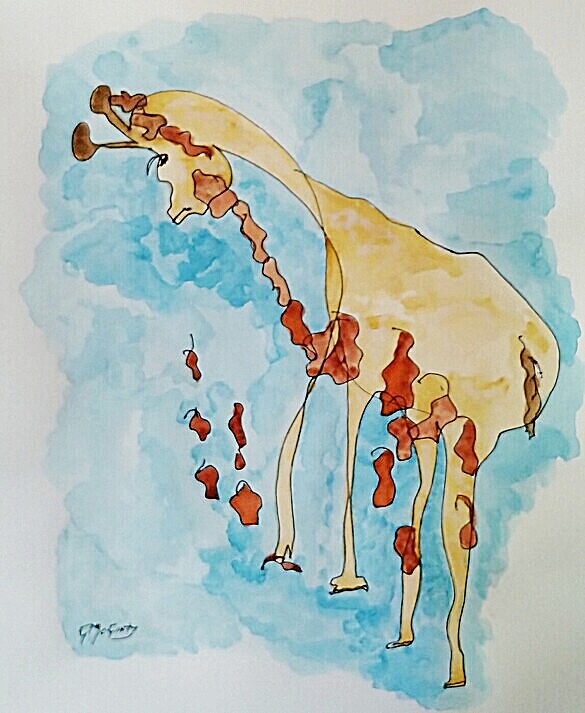
With a black ink pen, I closed my eyes and visualized a giraffe.
For five minutes, I kept my eyes closed and let my hand follow the contours of that internal image. Unlike a continuous line drawing, I allowed my hand to lift, move, and make whatever separate marks and strokes my mind needed to translate the image onto the paper.
I had no visual feedback—no way to check alignment, scale, or symmetry. I simply trusted the connection between my mind’s eye and the movement of my hand. When I felt the composition was complete, I opened my eyes. What was waiting on the page genuinely amazed me.
The composition was raw. I don’t think I could have ever achieved this result with my eyes open. The giraffe’s body was far more abstract than my usual style. Only a few spots rested on its head and the rest seemed to be falling off its body. Most striking of all was its face – a sad, disappointed expression that carried an unexpected emotional weight.
Had I drawn this with my eyes open, my analytical mind would have stepped in. I would have corrected the proportions, placed the spots with deliberate precision, and smoothed out the expression. By closing my eyes, I bypassed that inner editor and captured an authentic, surreal mood that felt entirely untamed.
To finish the piece, I opened my eyes and brought in watercolor. Working with the expressive ink foundation already on the paper, I laid down washes of color to complement the abstract composition and heighten the quiet, melancholic mood of the figure.
This exercise was a powerful reminder that sometimes our best creative work happens when we stop trying to control the outcome.
By shutting off my visual sight, I gave my intuition space to speak—and it created something I never could have planned.


Leave a comment